
Dyslexia and learning disorders: understand, assess, help
Some bright, hard-working children struggle to read, spell or write, or look clumsy with their hands and body. These difficulties often have a name: dyslexia, dysorthographia, dysgraphia or dyspraxia.
At Happy Brain Clinic in Tyre, Lebanon, and online for families across the Arab world, speech-language pathologists, neuropsychologists, occupational and psychomotor therapists assess your child and build a plan together, in Arabic, English and French.
- Arabic · English · French
- Children, teens & adults
- In Tyre or online
What are specific learning disorders?
They are neurodevelopmental: they are not caused by low intelligence, laziness or poor teaching, and they last over time. Early, accurate assessment changes the path.
Dyslexia
Difficulty reading words accurately and fluently, linked to how the brain processes the sounds of language (phonology). Reading is slow, effortful, with guessing.
Dysorthographia
Persistent spelling difficulties: many errors, confusion of similar sounds or letters, difficulty learning spelling rules. Often occurs with dyslexia.
Dysgraphia
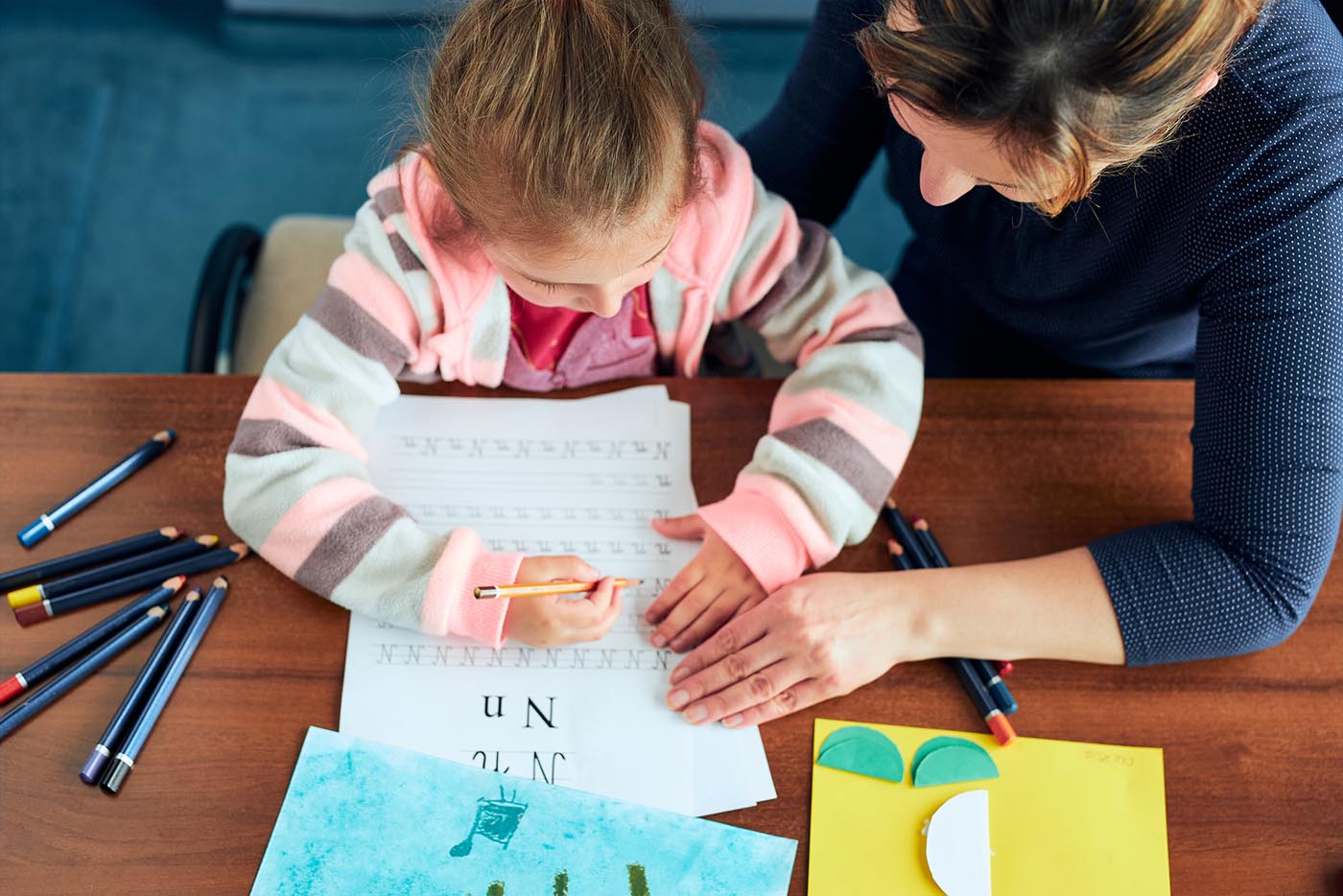
Difficulty with handwriting: slow, tiring, hard-to-read writing, poor letter formation or spacing.
Dyspraxia (DCD)
Developmental coordination disorder: difficulty planning and coordinating movements, affecting dressing, sport, handwriting and daily tasks.
Signs that should lead to an assessment
Before school
Late or unclear speech, difficulty with rhymes and syllables, trouble learning letter names and sounds.
Primary school
Very slow reading, confusing letters (b/d, ب/ت/ث), guessing words, many spelling errors despite effort.
Writing & motor
Messy or painful handwriting, avoids writing, clumsy, slow to dress or tie shoes, difficulty with ball games.
Feelings
Avoids reading aloud, says “I am stupid”, frustration, school refusal or anxiety before tests.
Learning to read in several languages
- Arabic readers move from vowelled text (with tashkeel) to unvowelled text, which demands strong language and vocabulary skills
- The gap between spoken dialect and written Arabic (diglossia) adds a challenge for every child, and even more for children with dyslexia
- Many children learn Arabic with English or French at the same time; dyslexia shows up in all languages, but differently
- We assess reading and spelling in each language your child learns, so we do not confuse a language gap with a learning disorder
A complete, multidisciplinary assessment
Each child does not need every test. We select what answers your questions.
Oral & written language
Phonological awareness, rapid naming, reading accuracy and fluency, comprehension, spelling and written expression.
Cognitive profile
Intellectual efficiency, attention, working memory, processing speed and executive functions; screening for ADHD, which often co-occurs.
Handwriting & daily skills
Fine motor skills, handwriting speed and legibility, organisation and daily-life autonomy.
Coordination & body
Motor coordination, balance, graphomotor skills and spatial organisation.
Clear conclusions
A written report with results, diagnostic conclusions when criteria are met, and practical recommendations.
Accommodations
Extra time, reading of instructions, adapted exams, reduced copying, use of a computer or audiobooks.
Worried about reading, spelling or writing?
Send us a message. Our team will tell you which assessment fits your child’s age and languages.
How we help after the assessment
Phonology & decoding
Explicit, systematic work on sounds and letter–sound links.
Reading fluency
Repeated, guided reading to read faster and with less effort.
Spelling & writing
Spelling patterns, word structure (roots and morphology) and handwriting.
Strategies
Comprehension strategies, organisation and study skills.
Tools
Audiobooks, text-to-speech, typing and assistive technology.
What the research says
Phonics-based instruction
A meta-analysis of randomised trials found systematic phonics instruction to be the best-supported approach for reading disabilities.
Task-oriented therapy for DCD
International recommendations favour activity- and task-oriented approaches for children with developmental coordination disorder.
Arabic-specific factors
Research shows that diglossia and vowelling affect reading in Arabic, especially for children with dyslexia.
Unproven “cures”
Coloured lenses, eye exercises or programs without evidence should not replace structured reading intervention.
Families in the Gulf and abroad
In person in Tyre
- Full standardised assessment
- Weekly therapy sessions
- Occupational and psychomotor therapy
- School meetings when useful
Online
- Parent consultation and guidance
- Reading and spelling therapy by video
- Arabic for children studying abroad
- Follow-up after an in-person assessment
Explore


Scientific and professional sources
- Galuschka et al. (2014), PLOS ONE: Effectiveness of treatment approaches for children and adolescents with reading disabilities, meta-analysis of randomized controlled trials
- ASHA Practice Portal: Written Language Disorders
- Blank et al. (2019), Developmental Medicine & Child Neurology: International clinical practice recommendations on developmental coordination disorder
- Schiff & Saiegh-Haddad (2017), Reading and Writing: When diglossia meets dyslexia, voweled and unvoweled reading in Arabic
What families say about us
Real Google reviews from families who worked with our team.


This organization enjoys high-level therapists, and they even develop every day to much higher levels as this field progresses.


Frequently asked questions
What is dyslexia?
Dyslexia is a specific learning disorder that makes it difficult to read words accurately and fluently. It is linked to how the brain processes speech sounds, not to intelligence or effort.
What is the difference between dyslexia, dysorthographia and dysgraphia?
Dyslexia affects reading, dysorthographia affects spelling, and dysgraphia affects handwriting. They often occur together and are assessed together.
What is dyspraxia?
Dyspraxia, or developmental coordination disorder (DCD), is a difficulty planning and coordinating movements. It affects daily activities, sport and handwriting.
At what age can dyslexia be diagnosed?
A diagnosis is usually made after formal reading instruction has started, often around age 7 to 8. Signs can be seen earlier, and early support should not wait for a diagnosis.
Can dyslexia be assessed in Arabic?
Yes. We assess reading and spelling in Arabic and in the other languages your child learns, taking into account vowelled and unvowelled reading and the gap between dialect and written Arabic.
Do adults get assessed for dyslexia?
Yes. Many adults were never diagnosed. An assessment can explain long-standing difficulties and support accommodations at university or work.
Can therapy be done online from the Gulf?
Yes. Parent guidance, reading and spelling therapy and follow-up can be done online. A standardised assessment is best done in person when possible.
Book a learning disorders assessment
In Tyre or online, in Arabic, English or French.